For consultants whose referrals have stopped arriving
7 reasons consultants spend real money on marketing and get no clients
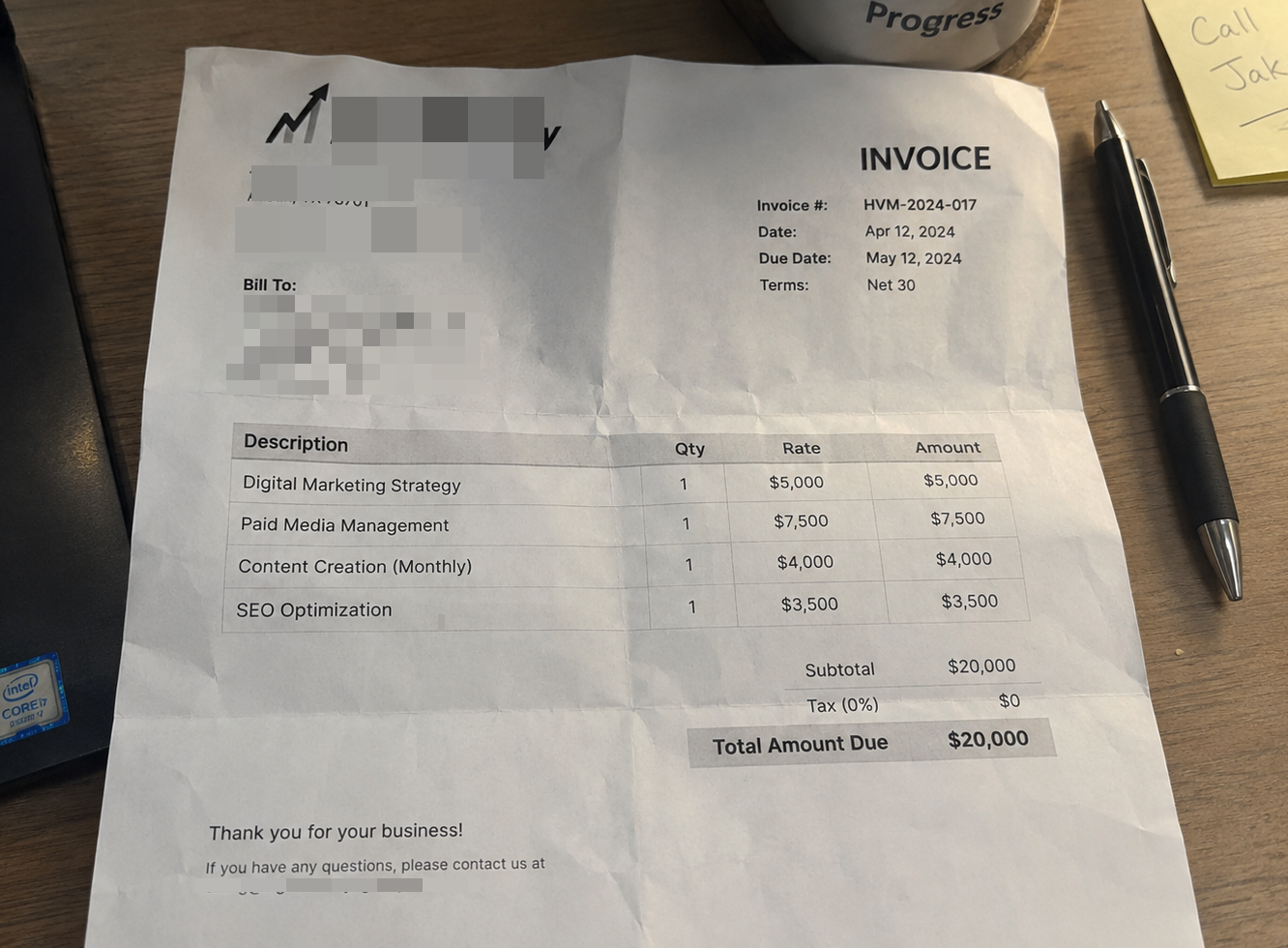
One consultant I know spent twenty thousand dollars with a marketing agency. Six months. He didn't get a single client. He didn't even get a single email address.
The obvious conclusion is that the agency was bad or that marketing doesn’t work. It's the wrong conclusion, and believing it is expensive, because it sends you looking for a better agency instead of at the thing that made twenty thousand dollars disappear.
You bought reach, and reach was never what was missing
Every dollar you have spent on marketing was aimed at the same thing: getting in front of more people. More impressions, more connections, more conversations at the top.
That spend assumes the problem is how many people see you. If it were, money would fix it, because money reliably buys attention. It's the one thing in marketing you can purchase outright.
You bought it. Nothing happened. That result is data, and it points somewhere other than the agency or marketing spend.
The agency needed a decision you had never made
Somewhere in the first week they asked who your ideal client is. You said something like: mid-sized companies, usually operations or finance, though honestly we work across a lot of industries.
That answer is true. It's also unusable. No one can write a headline against it, build a list from it, or target an ad to it.
So they did what agencies do with a fuzzy brief. They made it broad enough to cover everything you said. And broad copy addressed to everyone gets read by no one, which is not a failure of execution. It's a faithful rendering of what they were given.
Image
A real screenshot of vague consulting website copy, the "we help organizations unlock their potential" kind, with the vague phrases underlined. Use your own early copy if you're willing.
Your cold outreach had nothing in it to recognize
Maybe you skipped the agency and did it yourself. A few hundred messages, carefully written, politely ignored.
Read one of them back. It almost certainly describes what you do. Your experience, your approach, the kinds of results you get.
Nothing in it describes what the reader is living with. And a stranger will only stop for one thing: the sense that you are talking about their exact situation. Not your capability. Their Monday, literally.
You can send a thousand of those. The reply rate stays about the same, because the problem is in the message, not the volume.
You were still the only person who could explain it
So you brought in help. A contractor, a virtual assistant, someone part-time to do the outreach.
It rarely works. If the only person who can describe your value is you, then whatever you hand off arrives worse than it left. You haven't delegated business development. You've delegated a worse version of yourself.
Hiring someone to sell a thing that has never been defined just adds a salary to the problem.
You changed the channel every time, and never the message
The agency didn't work, so you tried outreach. Outreach didn't work, so you posted for a while. Posting didn't work, so you went back to networking.
Four attempts, four channels, one message. The same description of what you do, pushed through different pipes.
It's a reasonable way to think: when something fails, change the thing you can see. But the channel was never the variable. You have now run the same test four times and gotten the same answer four times, which is more evidence than most people will ever collect about their own positioning.
Referrals worked for years, so you never had to be describable
This is the part that often stings, and it isn't your fault.
Every client you've had came from someone who already knew you. A former colleague, a past employer, someone who saw your work firsthand. They didn't need you to explain anything, because they'd watched you do it.
So you never built the ability to be understood by someone who hasn't. For five years there was no cost to that. Then the names ran out, and every method you tried afterward required exactly the skill you'd never needed.
What worked isn't working anymore. That's not a market shift. That's the end of a list.
Image
Simple visual: a list of past clients with a line traced from each back to the same few original relationships. Hand-drawn is better than polished here.
All of it was downstream of a decision nobody made
Marketing amplifies a message. It does not decide what the message is.
The message has to be decided: which specific buyer, which urgent problem, in language they'd use themselves. If it hasn't been, every dollar you spend buys a louder version of the fuzziness. That's true of the agency, the outreach, the posting, and the next thing you try.
Prime example: twenty thousand dollars bought a very loud version of we do a lot of things.
Mark was sure the problem was that he wasn't good at selling
Mark runs an operations consultancy. When his revenue flattened, he assumed he wasn't closing well enough. So he made more pitches, sharpened his close, and pushed harder.
He worked at it for a long stretch. It didn't move.
What eventually changed his business wasn't better selling. He got specific about the one expensive problem he solved, built a way for buyers to understand that exact work, and gave them a structured way to see the problem through his expertise long before a proposal came into the picture.
His revenue went from $800,000 to $1.6 million in eighteen months. Not because he pushed harder. Because he stopped needing to.
Optional video
60 to 90 seconds. The single idea: money spent on reach cannot fix a message that was never decided. Talking head is fine.
So if it isn't the channel, and it isn't your closing ability, what is it?
Here's the uncomfortable place this leaves you in.
You now know the marketing spend didn't work, and not because you picked badly. It didn't work because it was pointed at a layer above the actual problem. Which means the next reach you buy will fail the same way, for the same reason, unless something underneath changes first.
But you don't yet have a name for what that something is. You can feel that "we do a lot of things" is costing you, and you can't see how to be narrower without turning away work you need this quarter. That tension is real, and it's why most consultants stay exactly where they are, not from an unwillingness to work hard, but because the fix looks like raising your hand for less at the worst possible moment.
It isn't. But that takes a whole article to show, and it's the next one in this series.
This is part of a short series on why consulting pipelines dry up and what actually refills them, drawn from the work behind Niche Consulting Growth and the Opportunity Engine Intensive.